यात्रा
Uttarakhand · Places to Visit
Kedarnath Temple
TempleRudraprayag, Uttarakhand
Last updated August 6, 2026
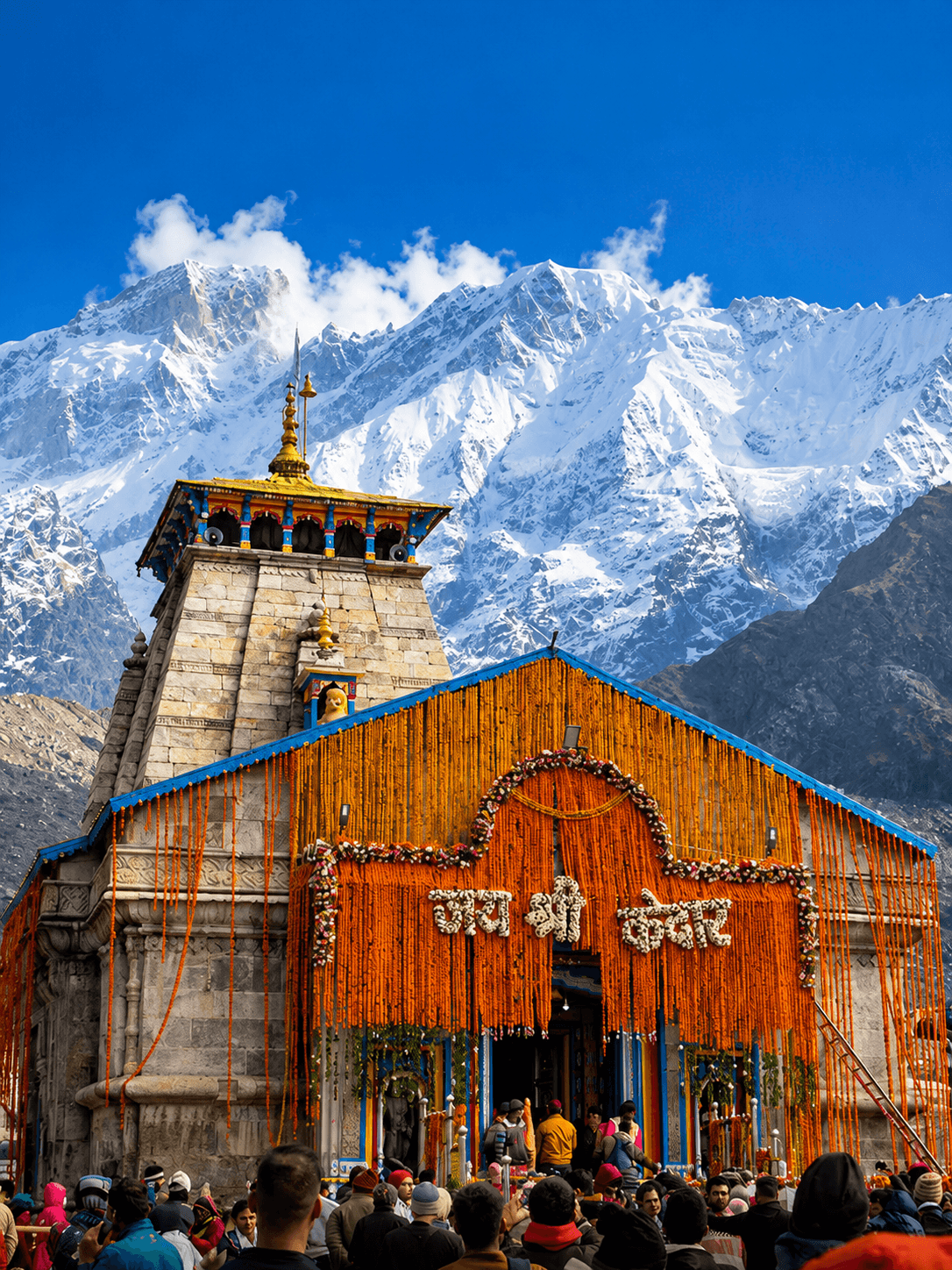
One of the twelve Jyotirlingas of Lord Shiva, located in the Garhwal Himalayas at 3,583 meters
Plan your trip
Essential Info
Best Time to Visit
May to October (temple opens only during these months)
Timings
Opens in April/May, closes in November (seasonal)
Before you pray
Deity & Rituals
Deity
Lord Shiva, worshipped here as one of the twelve Jyotirlingas
Aarti Timings
Morning: Around 4:00–5:00 AM (varies seasonally)
Evening: Around 6:30–7:30 PM (varies seasonally)
Prasad
Bhog offerings are distributed to pilgrims after the main aarti; timings and availability vary by season
Dress Code
Modest, conservative clothing covering shoulders and legs is expected; warm layers are also a practical necessity given the altitude
Visitor Etiquette
- Photography is not permitted inside the temple.
- Photography is generally restricted inside the inner sanctum out of respect for the sanctity of worship
- Pilgrims are expected to queue in an orderly line for darshan, especially during peak Yatra season
- Footwear must be removed before entering the temple premises
The story
History & Architecture
History
Local tradition holds that the Pandavas built the original shrine after the Mahabharata war, seeking Lord Shiva's blessing to atone for the deaths of their kinsmen; Shiva is said to have evaded them by taking the form of a bull and diving into the ground, leaving his hump behind for worship. The current stone structure is widely attributed to the 8th-century philosopher Adi Shankaracharya, who is believed to have revived the site as part of his broader project of restoring Hindu pilgrimage centers across India — a samadhi (memorial) associated with him stands just behind the temple. The temple has withstood centuries of harsh Himalayan winters and, more recently, the catastrophic June 2013 flash floods that devastated the region; the temple itself survived largely intact, an event widely reported at the time as reinforcing its sacred status for pilgrims, though the surrounding town was severely damaged and reconstruction continued for years afterward.
Architecture
Built from massive, precisely interlocked grey stone slabs without any binding mortar — a construction technique typical of North Indian Himalayan temple architecture of that era — the temple has little exterior carving, an austerity considered fitting for a shrine at 3,583 meters. The garbhagriha (inner sanctum) houses a conical rock formation worshipped as the Shiva lingam. The temple's thick walls and steeply pitched roof are built to shed heavy snow load through the long Himalayan winter, during which it closes and the deity is ceremonially moved to Ukhimath for six months.
Local lore
Myths & Legends
What locals say
Beyond the Pandava origin story, local legend holds that Shiva, fleeing the Pandavas in the form of a bull, dove into the earth at Kedarnath — his hump resurfaced here, while the rest of his form is said to have appeared at four other Himalayan sites now venerated together as the Panch Kedar. Pilgrims and locals also point to the June 2013 flood, when a massive boulder came to rest directly behind the temple and diverted the floodwaters around the structure, as an event many read as a sign of the shrine's protection — though the surrounding town suffered heavy damage and loss of life.
Through the years
Timeline
Key moments
c. 8th century CE
Adi Shankaracharya revives the shrine as part of restoring major Hindu pilgrimage sites across India
2013
Catastrophic Himalayan floods devastate the region; the temple structure itself survives largely intact
2013–2020
Multi-year reconstruction of the town and pilgrim infrastructure around the temple
Present
Kedarnath reopens each year from around late April/May to November as part of the Char Dham Yatra
Highlights
Main Attractions
Ancient temple dedicated to Lord Shiva
Surrounded by snow-capped peaks
Part of Char Dham pilgrimage
Mandakini River
Bhairavnath Temple
Beyond the obvious
Hidden Gems & Photography
Hidden Gems
- •Bhairavnath Temple, a short walk above the main shrine, offers a quieter vantage point over the valley and is dedicated to Kedarnath's traditional guardian deity
- •Vasuki Tal, a glacial lake roughly a half-day trek from Kedarnath, is far less visited than the main temple route
- •The Adi Shankaracharya samadhi directly behind the temple is often overlooked by pilgrims focused on the main shrine
Photography Tips
- •Early morning light just after the temple opens gives the clearest, haze-free views of the surrounding peaks
- •The reflection of the temple and mountains in the small pond near the complex is a popular but easy-to-miss composition
- •Respect posted restrictions on photography inside the sanctum — exterior and valley shots are generally fine, but check current temple rules on arrival
On the map
Location
Getting there
How to Reach
By Air
Jolly Grant Airport, DehradunDED
Distance: 238 km
By Train
Rishikesh Railway StationRKSH
Distance: 221 km
By Road
- •Dehradun to Gaurikund (by road)
- •Gaurikund to Kedarnath (16 km trek or helicopter)
Local Transport
TrekkingPoniesHelicopter servicePalanquin
Before you go
Safety & Travel Tips
- Kedarnath sits at 3,583m — altitude sickness is a real risk; acclimatize before ascending and consult a doctor first if you have heart or respiratory conditions.
- The 16 km trek from Gaurikund gains significant elevation; even fit trekkers should budget 6-8 hours and avoid starting after early afternoon.
- Weather changes rapidly at altitude — carry warm, waterproof layers even in the May-October open season, and check the forecast before setting out.
- Complete the Uttarakhand government's official Char Dham Yatra registration before travelling, and carry valid photo ID throughout the journey.
- Mobile network coverage is unreliable beyond Gaurikund — share your itinerary with someone before starting the trek.
Travel with care
Responsible Tourism
- Carry out all non-biodegradable waste — the fragile high-altitude ecosystem around Kedarnath has limited capacity to process trekker litter
- Avoid single-use plastics on the trek; refill water where facilities allow rather than buying bottled water at every stage
- Stick to marked trails — the terrain above Gaurikund is ecologically sensitive and prone to erosion where trekkers cut new paths
- Be mindful of pack animals on the trail; give mules and ponies room and follow guide instructions at narrow passes
Good to know
Frequently Asked Questions
You might also like